
1. Executive Summary: Five-Year Forecast and Strategic Imperatives
The Indian education sector is positioned at a major inflection point, driven by aggressive governmental policy and acute market demand for scalable, high-quality learning solutions. The next five years (2025–2030) are projected to transform Indian pedagogy through the widespread application of Artificial Intelligence (AI) technologies. This acceleration is fundamentally rooted in the directives outlined within the National Education Policy (NEP) 2020, which mandates the use of technology to improve quality and expand access.
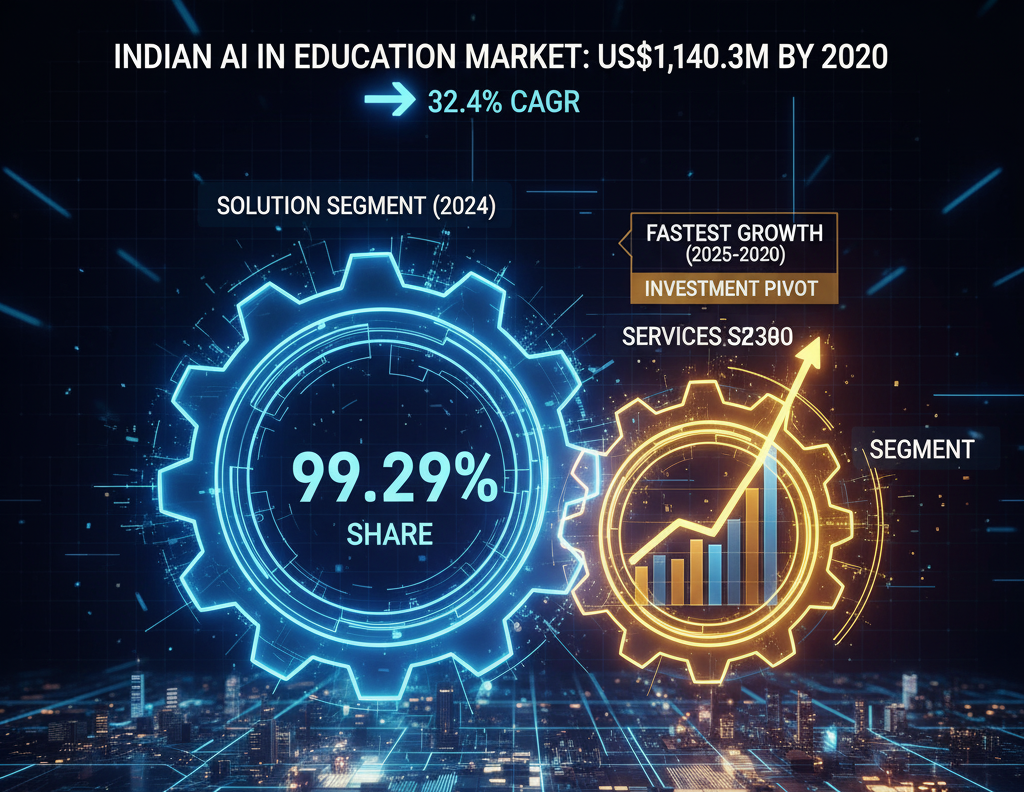
The primary catalyst for this rapid expansion is the government’s decision to mainstream AI education into the K-12 system, starting from Class 3 in the current academic year. This top-down mandate eliminates market uncertainty and guarantees high demand for AI-driven platforms, content, and specialized services. Quantitatively, the Indian AI in Education market is entering a phase of exponential expansion, projected to reach a total revenue of US$ 1,140.3 million by 2030. This robust growth trajectory is underpinned by a Compound Annual Growth Rate (CAGR) of 32.4% during the forecast period from 2025 to 2030.
While initial investment centered on proprietary Solution platforms, the market is quickly maturing. The most lucrative and fastest-growing investment opportunity over the next five years is projected to be the Services segment, which encompasses customization, deployment, teacher training, and systems integration. This shift signals a transition from platform invention to large-scale, equitable implementation across the diverse educational landscape of India.
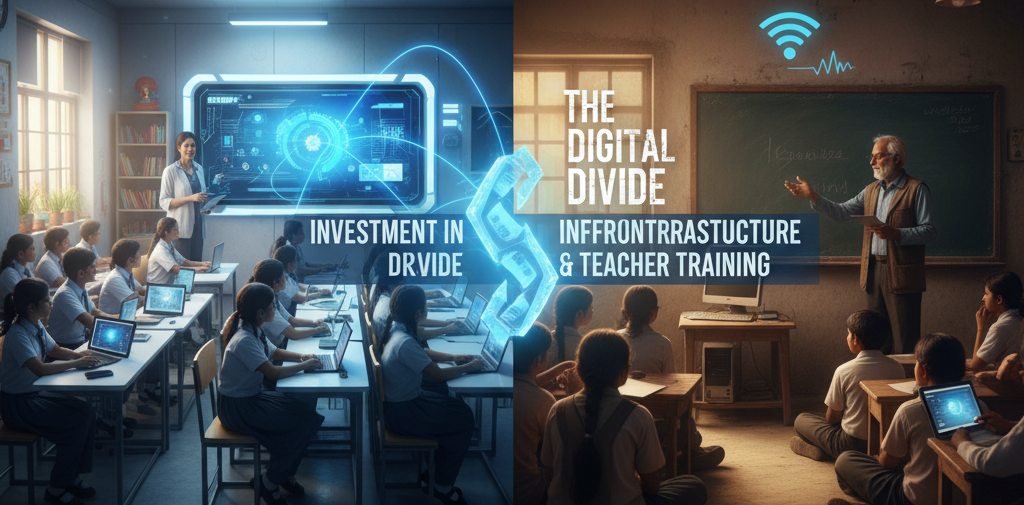
However, the realization of this vision is constrained by profound infrastructural and human capital challenges. Widespread AI integration depends critically upon mitigating the severe digital divide, where internet access is available in only 53.9% of schools nationally, with rates falling below 25% in certain resource-poor states. Overcoming these infrastructural hurdles, coupled with the rapid, comprehensive execution of mandatory teacher training programs, represents the strategic imperative for ensuring that AI integration leads to genuinely equitable and effective learning outcomes by 2030.

2. Policy and Regulatory Anchors: The Mandate for Acceleration
A. The Foundational Role of the National Education Policy (NEP) 2020
The NEP 2020 serves as the foundational legal and strategic framework legitimizing the massive integration of AI into the educational ecosystem. The policy emphasizes using technology to enhance the quality of education, expand accessibility, and offer personalized learning experiences, directly validating core AI applications. This pedagogical flexibility introduced by NEP 2020 supports greater customization, deeper student engagement, and improved accessibility, facilitating convenient, anytime, and lifelong learning regardless of location or pace.
A key directive of the NEP 2020 is the explicit mandate for curriculum integration. The policy originally recommended the introduction of AI and coding concepts starting from Class 6. This forward-looking measure is designed to equip students with critical digital skills for future careers, addressing the critical necessity for workforce preparedness, as industry estimates suggest nearly 70% of roles in India will undergo significant change in the coming years due to AI and automation. Graduates must move beyond theoretical knowledge and demonstrate competence in data analysis, creative thinking, and cross-disciplinary problem-solving, skills that the new curriculum aims to cultivate.
Furthermore, AI is essential for realizing the policy’s goals concerning assessment reform. The NEP 2020 calls for a fundamental shift away from rote memorization and exam-centric models towards continuous, holistic, and competency-based evaluation. AI-driven systems are uniquely positioned to meet this demand by enhancing accuracy, speeding up grading, providing instant feedback to students, and reducing the potential for human bias.
B. Government Acceleration and Implementation Timeline (2025–2026)
The commitment to AI deployment has moved rapidly beyond foundational policy towards immediate, compulsory execution. Union Education Minister Dharmendra Pradhan announced the rapid mainstreaming of AI, with plans to introduce AI-based education starting from Class 3 in the current academic year. This earlier-than-anticipated integration accelerates the timeline for both public and private sectors to develop, deploy, and scale age-appropriate AI modules and supporting infrastructure. This immediate, compulsory need for content and platforms is the primary factor guaranteeing the high demand necessary to realize the forecasted 32.4% market CAGR.
National platforms are being leveraged as the Digital Public Infrastructure (DPI) to facilitate this scale. DIKSHA, a key government initiative, currently serves millions of users, supporting over 182.3 million enrolments and accommodating 36 Indian languages. Its federated architecture allows states and union territories to customize the platform according to their specific curriculum needs, proving that AI tools can be localized and delivered at a massive scale. Similarly, the SWAYAM platform is being utilized for specialized courses and training.
State-level policy initiatives also provide crucial implementation models. The Odisha AI Policy 2025, for example, outlines a decade-long roadmap to integrate AI learning, establish AI labs, and ensure linguistic equity by tailoring AI lessons in local languages such as Odia and various tribal languages. These localized efforts demonstrate that successful integration requires adaptability and a commitment to address linguistic diversity, aligning technological innovation with the principles of inclusivity championed by the National Educational Technology Forum (NETF).
The pedagogical flexibility and customization introduced by NEP 2020 inherently increase the complexity of these educational AI systems. To safeguard student rights and educational integrity, the establishment of the NETF is critical. This body is responsible for establishing principles related to fairness, inclusivity, transparency, and accountability, ensuring that technology promotes human-centered education. Without robust governance to prevent algorithmic bias, the move towards personalization risks reinforcing existing systemic inequities, potentially favoring certain linguistic or socio-economic groups in learning recommendations.
3. Market Dynamics and Growth Projection (2025-2030)
A. Quantitative Market Assessment and Forecast
The Indian AI in Education market is entering an accelerated growth cycle, positioning it as one of the most dynamic sectors globally. Market analysis projects the total revenue of the Indian market to reach US$ 1,140.3 million by 2030, based on a Compound Annual Growth Rate (CAGR) of 32.4% from 2025.4 This domestic trajectory is consistent with global trends identifying the Asia Pacific region as the fastest-growing market segment in AI education.13
The primary drivers propelling this exponential growth include the policy mandates described above, the deep maturity of India’s domestic EdTech startup ecosystem, and the sustained demand for rapid workforce reskilling necessitated by industrial transformation.8
B. Market Segmentation Deep Dive: Solution versus Services
An analysis of market components reveals a critical transition in investment focus. In 2024, the Solution segment, comprising the core AI platforms, software, and proprietary algorithms, dominated the market, accounting for 99.29% of the revenue share.4 This indicates that the initial phase of AI adoption was driven by the creation and licensing of core technological products.
However, the forecast for 2025–2030 indicates a fundamental pivot. The Services segment—which includes implementation, maintenance, customization, consulting, and capacity building like teacher training—is projected to be the most lucrative and fastest-growing component.4 The acceleration of the Services segment suggests that the greatest challenges for companies and investors are shifting from invention (creating the solution) to adoption and integration (delivering the service) into complex institutional settings, such as government school systems and higher education institutions. Successful investors in this period will therefore prioritize companies specializing in state-level deployment contracts, Faculty Development Programs (FDPs), and content localization services.
AI in Education Market in India: 2024–2030 Forecast
| Metric | 2024 (US$M) | 2030 (Projected US$M) | CAGR (2025–2030) |
| Total Revenue | 196.4 | 1,140.3 | 32.4% 4 |
| Largest Segment (2024) | Solution (99.29% Share) 4 | N/A | N/A |
| Fastest Growing Segment | N/A | Services 4 | High (Projected) |
C. Key Industry Players and Ecosystem Maturity
The ecosystem is spearheaded by a strong presence of domestic EdTech firms, which have rapidly deployed adaptive learning technologies. Platforms such as Byju’s, Vedantu, Embibe, and Toppr utilize AI algorithms to understand student progress, offer personalized lessons, and provide 24/7 support through virtual teaching assistants and chatbots.14 These systems enable learners to solve doubts instantly and revise topics anytime, supplementing traditional classroom instruction.14
In higher education, institutions face a critical juncture, needing substantial investment to adapt curricula for the AI revolution.8 Universities are increasingly utilizing AI to analyze student data, predict future job trends, and design curriculum that explicitly bridges industry gaps.17 This is crucial because employers now demand graduates who possess the ability to analyze data and solve real-world problems, rather than merely knowing theory.8
While K-12 education garners significant policy attention, global market analysis indicates that Corporate Training and Skill Development represents the fastest-growing end-user segment, with one projection showing a 44.80% CAGR through 2030.13 Given the estimate that 70% of Indian jobs will be significantly reshaped by AI 8, higher education institutions and private training firms will drive substantial AI investment to rapidly upskill the existing and future workforce. This intense demand for AI-related skills further fuels the domestic market’s aggressive growth projection. Future success across all segments will depend on fostering a strong “triple helix” partnership between the government, academia, and industry to ensure curriculum relevance and talent development.
4. Advanced Applications: Transforming Pedagogy and Learning Outcomes
The utilization of AI in Indian education is moving beyond simple digitalization to a comprehensive overhaul of pedagogical methods, content creation, and evaluation.
A. Personalized and Adaptive Learning Pathways
AI is fundamentally transforming the traditional “one-size-fits-all” teaching model by enabling hyper-personalization. AI systems track student behavior, learning pace, and performance to create customized study plans, ensuring learning is both effective and enjoyable. Platforms analyze student performance, personalize lessons, and adjust the difficulty level of content dynamically.
Intelligent Tutoring Systems (ITS) exemplify this capability, providing targeted support adjusted to a student’s unique strengths and weaknesses, thereby maximizing efficiency and understanding. These systems have been developed to aid students across various subjects, including mathematics, introductory programming (such as the ESC101-ITS developed by IIT Kanpur), and natural language learning.
Crucially, adaptive learning is viewed as a vital tool for bridging India’s significant urban-rural educational disparities. Platforms are designed to deliver personalized learning paths that break down complex subjects into bite-sized lessons tailored to an individual’s learning pace. For example, some systems ensure that language is not a barrier by providing lessons and quizzes in multiple languages, including Hindi and English, and dynamically adjusting content difficulty to reinforce concepts without overwhelming the learner.
B. Generative AI (Gen-AI) in Content and Efficiency
Generative AI, which uses algorithms to create new content based on patterns in existing data, is essential for achieving scale and linguistic universality in Indian education. Gen-AI enables the instantaneous creation of high-quality, interactive materials, including quizzes, flashcards, study notes, interactive simulations, and gamified math problems. The use of interactive content, such as AI-powered virtual labs that allow students to conduct experiments without physical equipment, has been shown to improve information retention significantly.
Perhaps the most immediate and profound impact of AI is on teacher efficiency. AI tools can automate routine administrative tasks such as grading assignments, tracking attendance, and scheduling. Analysis indicates that this automation can free up to 40% of an educator’s time. This time is then reallocated away from repetitive, low-value tasks towards sophisticated mentoring, creative lesson refinement, and providing complex human-centric guidance. The teacher’s role is thus radically redefined, shifting the focus from task execution to strategic engagement, a significant pedagogical transformation.
Furthermore, given India’s unique challenge of supporting 22 scheduled languages, Gen-AI’s capacity to rapidly generate and translate high-quality content is a fundamental tool for achieving educational equity. This capability, combined with government platforms like DIKSHA , ensures that content quality is not diminished even when delivered in local, native languages, enabling universal accessibility. This capability is being formalized through the Human-in-the-Loop (HITL) model, where pilot projects involving organizations like the CBSE and NCERT integrate AI tools to rapidly create context-specific educational resources, which are then reviewed and refined by human teachers to ensure pedagogical relevance and quality.
C. The Revolution in Assessment Integrity and Efficiency
Student assessment is one of the most crucial aspects of the educational reform mandated by NEP 2020, and AI is playing a central role in its transformation. AI-powered systems allow for adaptive testing, providing faster, more accurate, and consistent grading against predefined rubrics, thus eliminating human error and subjectivity. This capability ensures students receive speedy, real-time feedback tailored to their individual needs, which is critical for timely intervention and support.
AI systems analyze large volumes of student performance data, yielding “data-driven insights” that identify trends, strengths, and specific problem areas. Instead of relying solely on a final grade, teachers gain access to the “why” behind a student’s performance, enabling them to design effective and informed teaching strategies.
Beyond learning assessment, AI is critical for maintaining academic integrity at scale. AI proctoring uses machine learning algorithms to monitor thousands of online test-takers simultaneously, either in real-time or through post-exam analysis. This technology provides the scalability necessary for large Indian universities conducting examinations across multiple locations and time zones, significantly reducing the logistical burden and ensuring high assessment integrity without needing extensive physical infrastructure.
5. The Challenge of Equitable Deployment: Digital Divide and Infrastructure
The ambitious policy roadmap for 2025–2030 confronts the reality of significant infrastructural limitations that threaten to undermine the equity goals of the NEP 2020.
A. The Critical Infrastructure and Competence Gaps
The immediate rollout of AI curriculum from Class 3, while strategically important, places an immense burden on an education system that currently lacks basic digital foundations in many areas. Data from the Department of School Education (2023-24) shows that only 57.2% of Indian schools had computers, and just 53.9% had internet access.
This national average masks severe regional disparities. In resource-poor states such as Bihar and West Bengal, internet and computer access rates drop dramatically, often falling below 25%. If AI adoption proceeds without massive, simultaneous public investment to close this gap, the digital innovation risks deepening existing inequalities. Elite urban schools, which are already technologically advanced, will flourish, while resource-poor government schools risk falling further behind, jeopardizing the goal of universal education access.
Compounding the hardware deficit is the skills gap. Digital literacy is a prerequisite for effective AI use, yet only 26.8% of Indian youth (in the 6-14 age group) possess basic internet browsing skills. In some regions, figures drop below 10%, indicating that mandatory digital literacy programs must be deployed alongside the AI curriculum rollout.5
The highly compressed timeline for implementing the Class 3 AI mandate compared to the sluggish pace of infrastructure development suggests a critical issue: if the foundational digital gap (53.9% internet access) is not closed rapidly, the policy will fail its equity objectives. The successful realization of the AI leap depends directly on large-scale, immediate public investment to meet the demand generated by the policy before the divide is cemented.
Infrastructure and Equity Barriers to AI Adoption
| Metric | National Average (2023-24) | Regional Lows (Bihar/West Bengal) | Implication for AI Adoption |
| Schools with Computers | 57.2% | < 25% | Limits institutional adoption of complex AI tools. |
| Schools with Internet Access | 53.9% | < 25% | Hinders access to cloud-based AI/EdTech platforms. |
| Youth with Basic Internet Skills (6-14) | 26.8% | < 10% (Meghalaya/Tripura) | Requires mandatory digital literacy programs alongside AI curriculum. |
B. Linguistic and Geographic Inclusion Strategies
India’s extensive linguistic diversity (22 scheduled languages) presents a unique technical and ethical challenge for AI scalability. To foster inclusion, the government is strategically focusing on AI-driven language platforms such as Bhashini and BharatGen.26 These platforms leverage advanced Natural Language Processing (NLP) and digitized language data to provide multilingual support across governance, healthcare, and education, ensuring that digital services and educational content are fully accessible regardless of the mother tongue.26 State-level policies, like Odisha’s tailored AI lessons, further demonstrate a commitment to linguistic equity in technology deployment.
The development of AI models must actively mitigate bias. AI systems rely on historical data, which can inadvertently carry biases related to language, region, or socio-economic factors. If these biases are not systematically addressed through ethical development frameworks, AI could reinforce existing inequalities instead of resolving them. Unlike models pursued by other large nations, India’s strength lies not in mimicking rapid, uniform rollout, but in designing an AI education model rooted in fairness, adaptability, and localization to manage its extraordinary internal diversity and development challenges.12
6. Human Agency and Capacity Building: The Role of Educators
The successful integration of AI relies less on the technology itself and more on the preparedness and capacity of the human agents—the teachers—who must orchestrate its use.
A. Teacher Training and Upskilling Roadmaps
The lack of competent educators remains a major hurdle for effective AI integration. Recognizing this, NEP 2020 explicitly mandates educator training to ensure the effective use of AI and continuous upskilling regarding technological advancements.
National initiatives are actively tackling this challenge. The Indian Institute of Technology Madras (IIT Madras) expanded its ‘AI for All’ 2.0 initiative to offer specialized, free AI courses to school teachers across all classes. These courses are designed to equip educators with essential AI knowledge and practical tools to enhance teaching, assessment, and student engagement. Similarly, SWAYAM Plus, in collaboration with Intel India, is launching focused Faculty Development Programs (FDPs) aimed at empowering educators with the latest developments in Artificial Intelligence.
The strategic significance of these FDPs is paramount. As established, AI can automate up to 40% of a teacher’s administrative tasks. The significant financial investment and high CAGR projected for the market will only yield a positive Return on Investment (ROI) in learning outcomes if this time saving is productively utilized. Educators must be trained not merely to operate the software, but to leverage AI analytics for curriculum refinement, focusing on complex, human-centric tasks like mentoring and motivational support. The massive scale of India’s K-12 system implies that the primary execution bottleneck for 2025–2030 will be the ability to scale high-quality, continuous training across all government school systems in their respective regional languages.
B. Ethical Governance and Responsible AI Frameworks
As AI systems become central to decision-making regarding student learning pathways, clear national standards are necessary to address data protection, algorithmic fairness, and accountability. Failure to establish such guidelines risks creating a generation educated through systems they cannot question or control, compromising the integrity of the learning process.
The NETF must establish and enforce robust principles on fairness, inclusivity, transparency, and accountability to ensure a human-centered approach to education technology. Stakeholders must reaffirm that AI is a powerful tool designed to amplify the crucial, dynamic relationship between the teacher, the student, and the learning material, rather than attempting to replace human conscience, judgment, or sense of responsibility. By prioritizing ethics and human agency, India can ensure that AI empowers learners and educators alike.
7. Strategic Roadmap and Conclusions for 2030
The period 2025–2030 represents the critical five-year window during which India must harmonize its ambitious policy goals (NEP 2020) with the grounded realities of implementation. The data indicates that the market is primed for financial growth, but equitable success hinges on addressing infrastructure and human capacity deficits.
The acceleration of the AI curriculum rollout starting from Class 3 creates an intense demand signal, driving the projected 32.4% market CAGR.3 However, the current infrastructural deficit (53.9% internet access in schools) represents a major vulnerability. If this gap is not closed rapidly and immediately, the policy’s aims of inclusivity will be severely undermined.5
The shift in market growth from the Solution segment to the Services segment signals that competitive advantage will be determined by firms specializing in large-scale integration, localization, and, most importantly, capacity building for teachers.4 AI must align with the NEP’s vision of competency-based learning, which requires standardization of assessment metrics (potentially through bodies like PARAKH) to prevent algorithms from simply perpetuating an overemphasis on rote memorization.
Strategic Recommendations for Policymakers and Industry
- Prioritize Infrastructure and Device Provision: A national mission focused on rapidly closing the 53.9% internet access gap by 2030 must be mandated, coupled with subsidized, standardized device distribution programs targeted at marginalized communities. This ensures that the policy mandate for AI education is matched by universal access.5
- Investment Pivot to Capacity Building Services: Investment strategies should prioritize the Services component, focusing on companies that provide scalable Faculty Development Programs (FDPs) and curriculum localization expertise. This strategic pivot is necessary to ensure that the 40% of time saved by AI automation is productively leveraged for pedagogical transformation.4
- Enforce Ethical and Multilingual AI Design Standards: The National Educational Technology Forum (NETF) must urgently finalize and enforce transparent guidelines regarding data privacy and algorithmic fairness.7 Furthermore, all future educational AI procurements must mandate support for all 22 scheduled languages, leveraging platforms like Bhashini to ensure AI systems are inclusive by design.12
Alignment of AI Applications with National Education Policy (NEP) 2020 Goals
| NEP 2020 Goal | Core AI Application | Indian Platform Examples | Projected Impact (2030) |
| Personalized Learning | Adaptive Learning Systems (ITS) | Embibe, Toppr, MindCraft 14 | Improved learning outcomes; customized pace/pathways. |
| Assessment Reform | Adaptive Testing / Automated Grading | Extramarks, AI Proctoring Systems 9 | Unbiased Evaluation; Real-time, formative feedback. |
| Technology Integration | Gen-AI Content Creation | YouTube (Content tools), DIKSHA 10 | Rich, engaging, and interactive digital resources. |
| Multilingualism | Gen-AI/NLP Translation/Content | Bhashini, BharatGen 26 | Bridging Language Barriers; Universal accessibility in native languages. |


Leave a Reply